
Imagine a salesperson who works 24/7, never complains, and consistently delivers high-quality leads that are primed and ready to buy. Does that sound too good to be true?
This is precisely what Content Marketing can do for your business.
Unlike traditional advertising, which often interrupts customers, content marketing earns their attention by providing massive value before asking for a sale. This guide is your primer to mastering content marketing.
🖼️ IMAGE IDEA: A modern illustration of a laptop showing a blog, video, social media post, and email connecting toward a shopping cart/sale icon.
Suggested image placement: After this introduction.
❓ What Is Content Marketing?
Content Marketing is a strategic marketing approach focused on creating and distributing valuable, relevant, and consistent content to attract and retain a clearly defined audience—and, ultimately, to drive profitable customer action.
In simple words, content marketing means creating useful content that helps your audience solve a problem, learn something new, or make a decision—and eventually encourages them to take action.
✨ The Core Elements of Content Marketing
        ┌─────────────────────────────┐
        │   THE CORE OF CONTENT       │
        │        MARKETING             │
        └──────────────┬──────────────┘
                       ↓
             ┌──────────────────┐
             │  1. Valuable ✨  │
             └────────┬─────────┘
                      ↓
             ┌──────────────────┐
             │  2. Relevant 🎯  │
             └────────┬─────────┘
                      ↓
             ┌──────────────────┐
             │ 3. Consistent 🗓️ │
             └──────────────────┘
The goal isn’t just vanity metrics like “likes” or “shares.” Effective content marketing guides customers through their journey, moving them from being unaware of your brand to becoming loyal advocates.
🗺️ The Content Marketing Customer Journey
Content is the fuel for your marketing funnel. Here is how you use content to drive customers through each stage:
        👀 AWARENESS
             ↓
        🤔 CONSIDERATION
             ↓
        🏆 DECISION
             ↓
        ❤️ LOYAL CUSTOMER
🖼️ DIAGRAM IDEA: Create a simple funnel graphic showing:
Awareness → Consideration → Decision → CustomerThis would work very well as a visual break between sections.
1. Awareness Stage (TOP of Funnel) 🔍
- The Problem: The potential customer is experiencing a symptom (e.g., “Why isn’t my website getting traffic?”) and is looking for a general definition or a solution.
- Your Goal: Get on their radar by providing introductory educational information.
- Content Formats: SEO-friendly blog posts (like “What Is SEO?”), explainer videos, infographical content, and simple “how-to” guides.
💡 Key idea: At the awareness stage, focus on educational content rather than directly trying to sell.
2. Consideration Stage (MIDDLE of Funnel) ⚖️
- The Problem: The customer now understands their problem (“I need better SEO”) and is actively evaluating different approaches and providers.
- Your Goal: Demonstrate that your solution or service is the most logical choice. Prove your expertise.
- Content Formats: Product comparison guides, in-depth ebooks, webinars, and case studies.
📌 At this stage, valuable content helps build credibility and trust.
3. Decision Stage (BOTTOM of Funnel) 🏆
- The Problem: The customer is ready to select a provider (“Should I hire Company X or buy Software Y?”).
- Your Goal: Overcome final objections and close the sale.
- Content Formats: Free trials, direct consultations, product demos, discount codes, and customer testimonials.
🎯 At this stage, your content marketing strategy should make it easy for customers to take the next step.
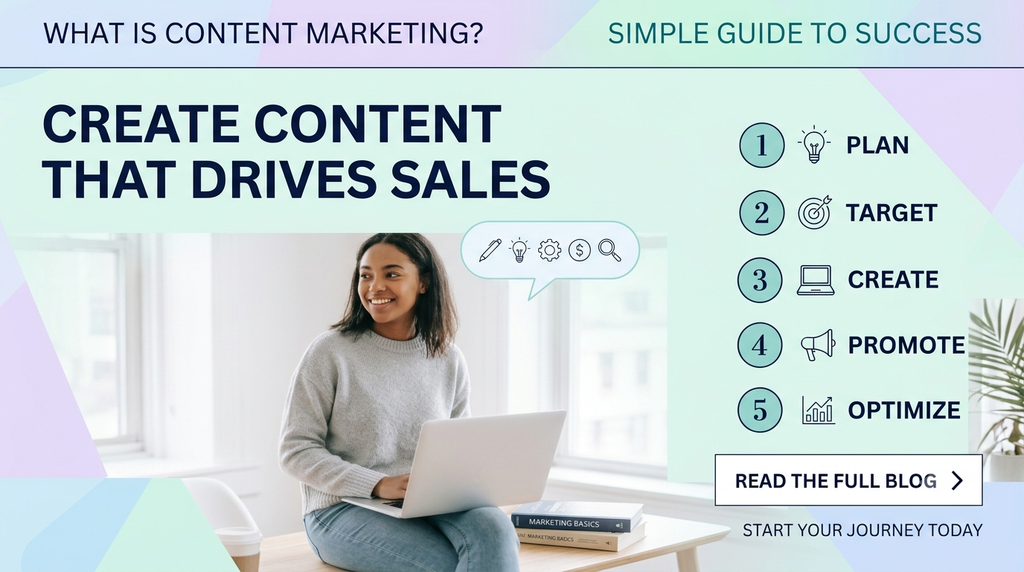
🎯 5 Crucial Steps to Create Content That Drives Sales
Many businesses make the mistake of creating content about themselves. To drive sales, your content must be about your customer.
1. Understand Your Ideal Customer (Buyer Persona) 👥
You cannot provide value to everyone. Create a detailed profile of your perfect client:
- What are their main problems?
- What are their fears or objections?
- Where do they hang out online?
- What does “success” look like for them?
Understanding your buyer persona helps you create content that connects with your target audience.
🖼️ IMAGE IDEA: A simple customer persona illustration with icons for:
👤 Audience
❓ Problems
🎯 Goals
💻 Online Platforms
2. Conduct Strategic Keyword Research 🔎
Find out the exact phrases your persona is typing into Google. Target:
- Informational Keywords: Phrases that ask “what is…” or “how to…” (Awareness stage).
- Transactional Keywords: Phrases like “best digital marketing agency in…” or “competitor X vs competitor Y” (Consideration/Decision stage).
🔎 Keyword Intent Diagram
SEARCH INTENT
     │
     ├── 📚 Informational
     │       ↓
     │    Learn / Understand
     │
     └── 🛒 Transactional
             ↓
        Buy / Take Action
Using relevant SEO keywords naturally in your content can help search engines understand what your page is about.
3. Create “Value-First” Content ✨
Your content must be the absolute best resource available on that topic. Google prioritizes helpfulness. Don’t just regurgitate common knowledge; add unique insights, original data, or personal case studies.
Solve the user’s problem completely so they don’t need to search elsewhere.
💡 Value-First Content = Helpful + Relevant + Original + Actionable
🖼️ IMAGE IDEA: A clean illustration showing:
Problem → Helpful Content → Solution → Trust
This is especially useful for explaining how content marketing drives sales.
4. Master the Call-to-Action (CTA) 📢
This is the single most important element for driving sales. Never publish a piece of content without a clear next step.
- Awareness Post CTA: “Want to master SEO? Download our Free 30-Day SEO Checklist.”
- Decision Post CTA: “Ready to grow your revenue? Schedule your Free 15-Minute Consultation.”
🎯 CTA Journey
CONTENT
   ↓
INTEREST 👀
   ↓
TRUST 🤝
   ↓
ACTION 👉
   ↓
LEAD / SALE 💰
A strong Call-to-Action (CTA) tells the reader exactly what they should do next.
5. Promote and Repurpose Consistently 🗓️
Publishing is only 20% of the work. Spend 80% of your time promoting your content via:
- Email Marketing ✉️
- Social Media Distribution 📱
- Repurposing (e.g., turning a blog post into an infographic or video) 🔄
♻️ Content Repurposing Example
       📝 ONE BLOG POST
              │
      ┌───────┼────────┐
      ↓       ↓        ↓
   📱 Reel  📊 Infographic  📧 Email
      │       │        │
      └───────┼────────┘
              ↓
       👥 MORE AUDIENCE
Content repurposing allows you to get more value from one piece of content by adapting it into different formats.
📈 How Does Content Marketing Drive Sales?
Content marketing for sales works by building trust before asking customers to buy.
Useful Content
      ↓
Audience Attention 👀
      ↓
Trust & Engagement 🤝
      ↓
Leads 🎯
      ↓
Conversions 🛒
      ↓
Repeat Customers ❤️
When people repeatedly find your content useful, they are more likely to remember your brand and consider your products or services when they are ready to buy.
🖼️ IMAGE IDEA: Use a clean horizontal visual showing:
Content → Trust → Leads → Sales
⚠️ Common Content Marketing Mistakes
Even good businesses can struggle when their content marketing strategy is not focused.
Common mistakes include:
- ❌ Creating content without understanding the target audience
- ❌ Focusing only on selling
- ❌ Ignoring keyword research
- ❌ Publishing content inconsistently
- ❌ Creating content without a clear goal
- ❌ Forgetting to add a CTA
- ❌ Not promoting existing content
- ❌ Not checking content performance
Avoiding these mistakes can make your content marketing efforts more focused and effective.
📊 How to Measure Content Marketing Success
Creating content is only one part of the process. You should also measure whether your content is achieving your business goals.
Some useful metrics include:
- Website Traffic 🌐
- Organic Traffic 🔎
- Engagement 💬
- Time on Page ⏱️
- Leads Generated 🎯
- Conversions 💰
- Email Sign-ups ✉️
The right metric depends on your goal. For example, a beginner’s blog may focus on organic traffic, while a product page may focus more on conversions.
📌 Summary
Content marketing is not a quick fix; it is a long-term asset that compounds over time. While paid ads stop bringing leads the moment you stop paying, great content continues to attract organic traffic and build trust for years.
Start by creating content that genuinely helps your customer, and the sales will naturally follow.
🚀 Remember:
Create Value → Build Trust → Attract Customers → Drive Sales